More than 600 species of birds have been recorded in the Philippines, an awesome number given a relatively small country.
Yet ask a Pinoy kid what Philippine bird species he knows and he can probably come up with ten, including those not normally occurring in the Philippines, like those darn-cute penguins, toucans and the American bald eagle (a raptor that is actually a lot smaller than our spectacular, albeit almost-extinct due to deforestation, Philippine Eagle).
It’s not the kids’ fault that they know so little of Philippine avian life. Or that they know more about cartoon ones like Daffy Duck or Tweedy Bird, or non-native species like penguins and robins than local species like the Philippine Duck and the Celestial Monarch.
Natural history—wildlife and outdoors appreciation—does not feature prominently in our school system. Nowadays, the grim economic reality makes it prudent to produce nurses, welders, and healthcare professionals for export rather than wildlife biologists, naturalists and scientists who will study our own flora and fauna.
In school, what we have are the annual visits to the zoo to “learn” about animal behavior, despite the fact that caged animals act, even sometimes look, different from their cousins in the wild. Caged parrots, for instance, stop grooming and cleaning themselves causing gunk to matte and destroy their naturally beautiful tails. Wild parrots are lustrous and the clean, well-maintained tail feathers are a source of a male’s pride. Once you have observed at length a parrot sunning itself in the wild, showing off its well-kept feathers and bright-red bill for the world to admire, you’ll realize how a filthy and tiny cage can destroy an animal’s spirit and pride. Zoo visits have their educational uses, of course, but they should not be substitutes to saving and observing animals in their natural habitats.
Let’s see, what birds can you name? Maya? Philippine Eagle (formerly known as Monkey-eating Eagle)? Tamsi? Tarat? Kuwago? Uwak? Tagak? Pugo? Tikling? Loro?Kolasisi?Kalaw?
Oldtimers can probably still identify and differentiate the lawin, agila, mamuhag, sakbit, bangkas, tikwe, limbas, labuyo, salagunting, talabong, lapay, kamaboy, kanduro, tariktik, balikasyaw, manunubing, salaksak and mamumugot.
Former hunters can probably tell you the differences among punay, alimukon, tukmo, balud, bato-bato and punyalada. They will also exaggerate their stories, while at it.
Pinoys who can tell you the difference between the kandarapa and the hagibas are becoming rarer. Those who can differentiate loro, abucay and kolasisi probably number more, although these birds are becoming rarer due to illegal collection for the bird trade and destruction of forests—their homes.
Those who think the national bird is still the maya (Chestnut Munia) are mistaken; it’s the Philippine Eagle. And then again, what is a maya? We have lots of “mayas”: mayang-bahay, mayang-kawayan, mayang-kosta, mayang-paking and mayang-dampol. There’s even a so-called “Baclaran maya,” those poor juvenile munias and sparrows which are hand-dyed blue, green or maroon by vendors and sold to kids outside the Baclaran church, along with Crested Mynas and Javan Sparrows. Sometimes, one sees these artificially-colored “Baclaran mayas” in the wild, escapees, joining their natural-colored kin. So when you see a maroon-colored maya zipping by, don’t call National Geographic yet to report a new discovery, chances are that red dye will wash off after a few rainy days.
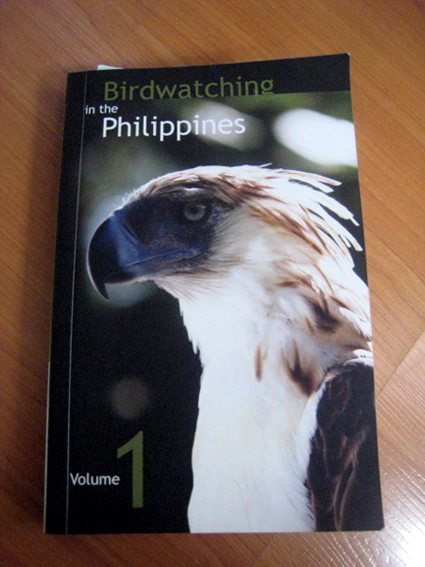
Amid this dearth of information, any effort to increase public awareness about the plight of Philippine wildlife is welcome.
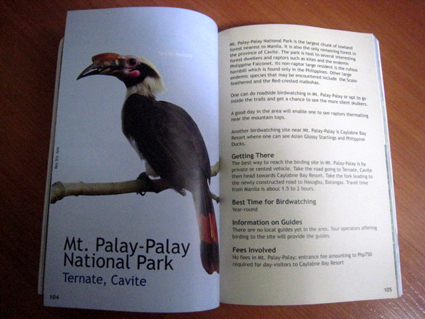
The newly-produced “Birdwatching in the Philippines Vol. I” is therefore a timely addition to the literature. This handsome book, produced by the Department of Tourism with help from The Wild Bird Club of the Philippines and Recreational Outdoor Exchange (R.O.X.), was designed by Robert Alejandro and written by Carlos M. Libosada Jr.
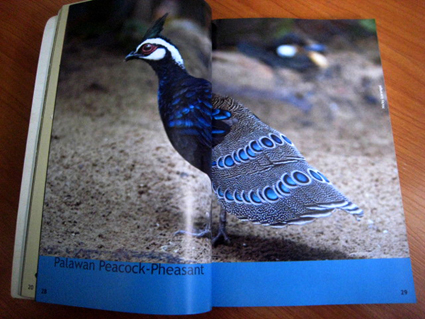
The book features photos of birds seen in the Philippines by leading Pinoy or Philippines-based wildlife photographers like Tina Mallari, Ivan Sarenas, Bobby Kintanar, Benedict de Laender, Nicky Icarangal, Orly Punzalan, Luis Limchiu and Nilo Arribas. The book shows the basics of responsible birding in the Philippines.
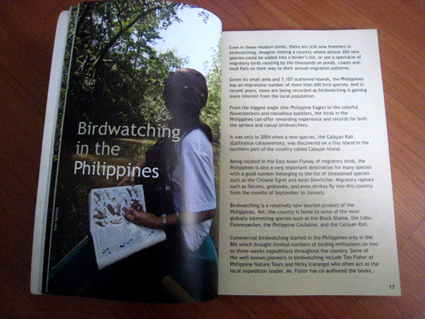
It’s human nature to save anything enjoyable. While various Philippine environmental NGOs are knee-deep in the nitty-gritty and often thankless (and not enjoyable) job of working with local communities to help preserve our forests and other natural habitats, this DOT book aims to make birdwatching an enjoyable pastime for foreign and local tourists. It is hoped, that when more Pinoys enjoy the wildlife around them, they will take an active interest in preserving these wild places and creatures, and not pave them over to make way for casinos, condos and parking lots.
What worries me about the fate of the almost-extinct Philippine Eagle is that most Pinoys don’t really enjoy this magnificent species outside of cages. Pinoys have become so used to seeing Philippine Eagles inside cages that there seems to be no urgent action—aside from pockets of conservation like the Philippine Eagle Foundation—to save the Eagle’s remaining wild population, or to seriously stop the cutting of native Philippine hardwoods, the preferred nesting trees of this unique raptor. If the Philippine Eagle goes extinct in the wild, it will be a damning indictment of Filipinos—a people who cannot even save its own national bird!
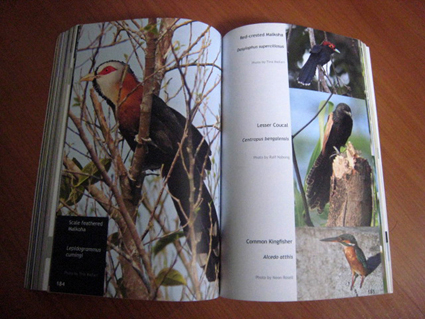
To observe and record birds in the Philippines, one needs a reliable guidebook. For all its nice features, “Birdwatching in the Philippines Vol. 1” is not a guidebook that will help one identify birds in the wild. It will not, for example, help you separate a Buzzing Flowerpecker from a Pygmy Flowerpecker, or a Chinese Goshawk from a Japanese Sparrowhawk. The only bird book guide for the Philippines remains “A Guide to the Birds of the Philippines” by Robert S. Kennedy etal. which is published by Oxford University Press. Unfortunately, this is not available in local bookstores.
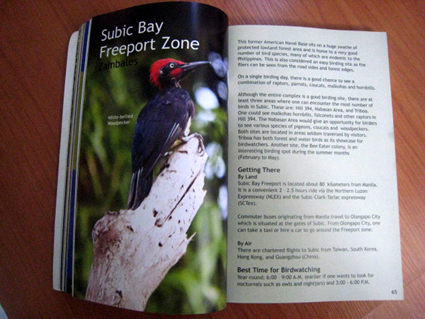
But despite its limitations as a guidebook, “Birdwatching in the Philippines Vol. 1” is a good book for the beginner birder and budding naturalist to have. Some people I know always get goggle-eyed when I show them a picture by Tina Mallari of a White-bellied Woodpecker, a species found in the Philippines. Yep, we have woodpeckers in the Philippines, although, since they need extensive stands of forest to survive, they need our help. Clear-cutting of forests to make charcoal and furniture is dooming our woodpeckers.
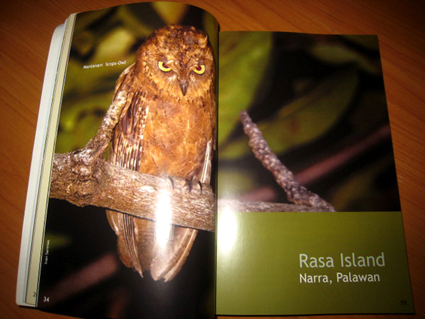
Another family of birds that are harmed by our rapacious need for forest resources are owls. Little-understood, owls need big stands of trees to rest in during the day.
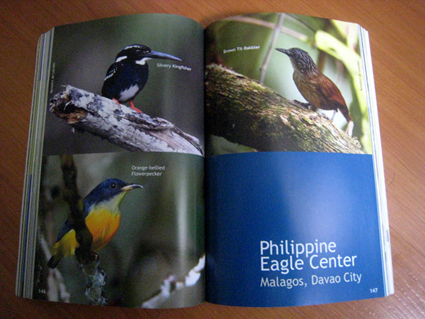
Aside from the larger, easier-to-see ones, we have a host of tiny, unobtrusive species like the smart-looking Silvery Kingfisher which can only be found in Mindanao, Bohol, Leyte and Samar. It has a chic black-and-white ensemble and bright-red “boots.” A photo of an individual by Benedict de Laender appears in this book.
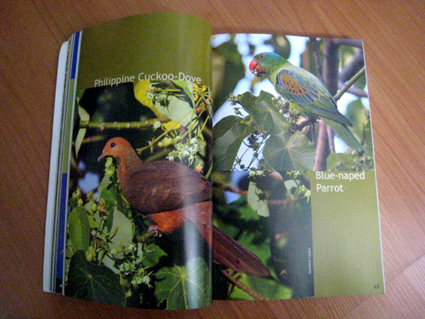
And of course, a beautiful Blue-naped Parrot foraging on the tree canopy, by Tina Mallari, can also be seen in this book. Hopefully, people will note the difference here between caged and wild parrots and put an end to the practice of caging birds. If we take the time to search and observe these birds, we’d realize what a colorful country we have. If only we’d take better care of it.
All the birds require is that we leave them alone. Leave their nests alone, leave their feeding trees alone, leave their nesting-trees alone, leave the trees where they perform their courtships, leave the trees where they raise their young, leave the trees where they rest and sleep. Respect: It’s really not too much to ask


